

Price per square foot is one of the most quoted figures in property. Buyers use it to compare homes. Sellers use it to justify an asking price. Agents use it as a shorthand in reports. It feels scientific. It feels fair. But when it comes to country houses, this simple number can lead buyers and sellers badly astray.
The reason is straightforward. Price per square foot works best when properties are similar in type, age, layout and setting. It was designed for flats and modern estate homes, where one three bedroom semi looks much like the next. Country houses rarely fit that mould. They vary enormously in style, history, land, and condition. Squeezing them into a single average figure hides more than it reveals.
Land changes everything
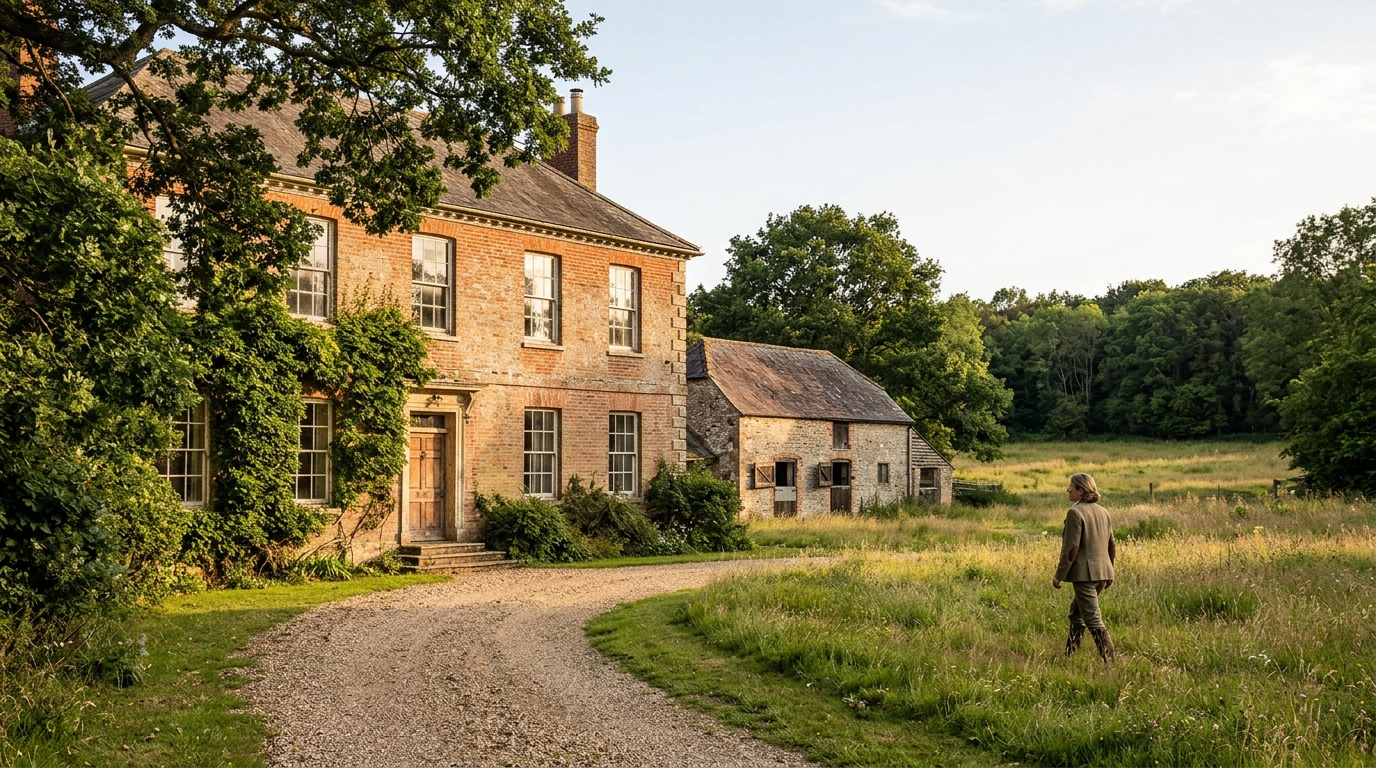
A country house often comes with paddocks, gardens, woodland or a few acres of grazing. None of that space counts toward the internal square footage, yet it can be the single biggest reason a buyer falls in love with the property. Two houses with identical floor plans can have wildly different values once you account for what surrounds them. A price per square foot calculation ignores this completely, because it only measures what is inside the walls.
This is why relying on a headline figure can make a house with land look expensive compared to a plain suburban home, when in fact the land is doing much of the work in the valuation. The comparison was never fair to begin with.
Outbuildings and annexes do not fit neatly into the sum
Barns, stables, garages and annexes add real value, but they rarely convert cleanly into the main square footage figure. Some agents include them, some do not, and buyers often struggle to know which is which when comparing listings. A converted barn with planning permission for residential use is a different proposition to a tumbledown store shed, yet both might appear as a vague addition to total floor area. When outbuildings are involved, price per square foot becomes even less reliable as a comparison tool.
Age and character carry weight that numbers cannot capture
A Georgian farmhouse with original fireplaces, high ceilings and mature gardens will often command a premium that has nothing to do with its floor area. Buyers are paying for character, history and a sense of place. A modern extension might add square footage cheaply, but it rarely adds the same emotional value per foot as an original room with proportions and features that cannot be recreated.
This is one of the biggest traps in using price per square foot for older homes. It assumes every square foot is equal. In a country house, it almost never is. The kitchen extension and the original drawing room might be the same size, but they are not worth the same to a buyer looking for a specific kind of home.
Condition swings the number sharply
A country house needing full modernisation can look like a bargain on a price per square foot basis, right up until a buyer adds up the cost of rewiring, replumbing, damp treatment and a new roof. On paper the figure looks attractive. In reality, the true cost of ownership is far higher than the headline number suggests. Buyers who focus only on the per square foot price without factoring in renovation costs can end up overpaying once the full picture becomes clear.
Location within the plot matters as much as location on the map
Two country houses in the same village can have very different values depending on their outlook, privacy, and how they sit within their grounds. A house tucked away with a private drive and open views will often be worth more than one that sits close to a road, even if their internal square footage is identical. Price per square foot cannot capture setting, aspect or privacy. These are qualities that buyers feel when they walk the grounds, not figures that show up in a spreadsheet.
What buyers and sellers should do instead
Price per square foot is not useless. It has a place as one data point among several. But it should never be the only measure used to value or compare country houses. A more reliable approach looks at genuine comparable sales, taking into account land, outbuildings, condition and character together, rather than reducing a property to a single average figure.
Sellers should be wary of any valuation that leans too heavily on this metric without discussing what makes their specific property different. If an agent quotes a price per square foot figure without asking about the history of the house, the quality of the land, or the condition of outbuildings, that is a sign the valuation has not gone deep enough.
Buyers should use the same caution. A house that looks expensive on a per square foot basis might be excellent value once you account for the land, the setting and the quality of the build. A house that looks cheap by the same measure might carry hidden costs that only show up once you dig into its condition and history.
In markets where homes can take time to sell, this distinction matters even more. Data across a wide sample of areas shows an average time on market of around 190 days, with roughly 27 percent of listings reaching a sold subject to contract stage at any one time. In a slower moving market like this, getting the valuation right from the start matters more than ever. A price built on a flawed per square foot calculation can leave a property overpriced and sitting unsold for months, or undervalued and sold too quickly for less than it was worth.
The average price across a broad sample of areas sits at £877,842, a figure that reflects a wide mix of property types, land sizes and conditions. That average alone tells you little about any individual country house. It is a reminder that averages, like price per square foot, are useful only as a starting point for a conversation, never as the final word.
The lesson for anyone buying or selling a country house is simple. Treat price per square foot as one clue among many, not a verdict. The real value of a country house lies in its land, its character, its condition and its setting, none of which fit neatly into a single number. A proper valuation takes the time to weigh all of these together, and that is the only way to arrive at a figure that truly reflects what the property is worth.