

The Bank of England's Monetary Policy Committee gathers this week for a decision that, on paper, should surprise nobody. Every one of the 65 economists polled by Reuters between September 4 and 8 expects the Bank to hold its base rate at 3.75% on Thursday. And yet the vote itself has become almost secondary to the argument happening underneath it, an argument that is already pushing up the cost of borrowing for anyone trying to buy a home in Kent this autumn.
A Hold That Isn't As Settled As It Looks
Rate setters have kept the Bank Rate at 3.75% for five consecutive meetings now, but the committee is not of one mind. At the last decision in July, three of the nine MPC members, Huw Pill, Megan Greene and Catherine Mann, voted to raise rates immediately to 4%, up from two dissenters at the previous meeting. That is a growing minority, not a shrinking one. Pill, the Bank's Chief Economist, has made his position plain. "We cannot wait for uncertainties to resolve themselves before acting," he said, a line that captures the impatience building among a section of the committee even as the majority continues to favour caution.
Nearly 90% of the economists in that Reuters survey, 57 out of 65, still expect the Bank to hold rates for the rest of the year. But eight are now forecasting a rise to 4% before December, and financial markets have been pricing in higher borrowing costs for weeks. That is the real story here. It is not whether the Bank moves this Thursday, almost nobody thinks it will, but whether the hawks on the committee are winning the argument for later in the year.
The Market Has Already Made Its Move
Swap rates, the wholesale funding costs that lenders use to price fixed mortgage deals, have climbed to a three-year high. That has fed through into mortgage pricing over the past ten days, regardless of what the MPC actually decides on Thursday. Lenders do not wait for the announcement, they price in the expectation, and the expectation right now is that rates stay higher for longer than buyers had hoped earlier in the year.
The effect is already visible in the Bank's own lending figures. Net mortgage approvals for house purchases fell to 56,100 in July, down 2,100 from 58,200 in June, having briefly looked like they were recovering. The effective interest rate on newly drawn mortgages rose to 4.45% in July, up from 4.35% the month before. Inflation running close to 2.9%, driven in part by energy costs linked to the conflict in the Middle East, is giving the hawkish members of the committee plenty of ammunition, even if the majority still judge that a loose labour market will do the disinflationary work for them over time.
What It Means On The Ground In Kent
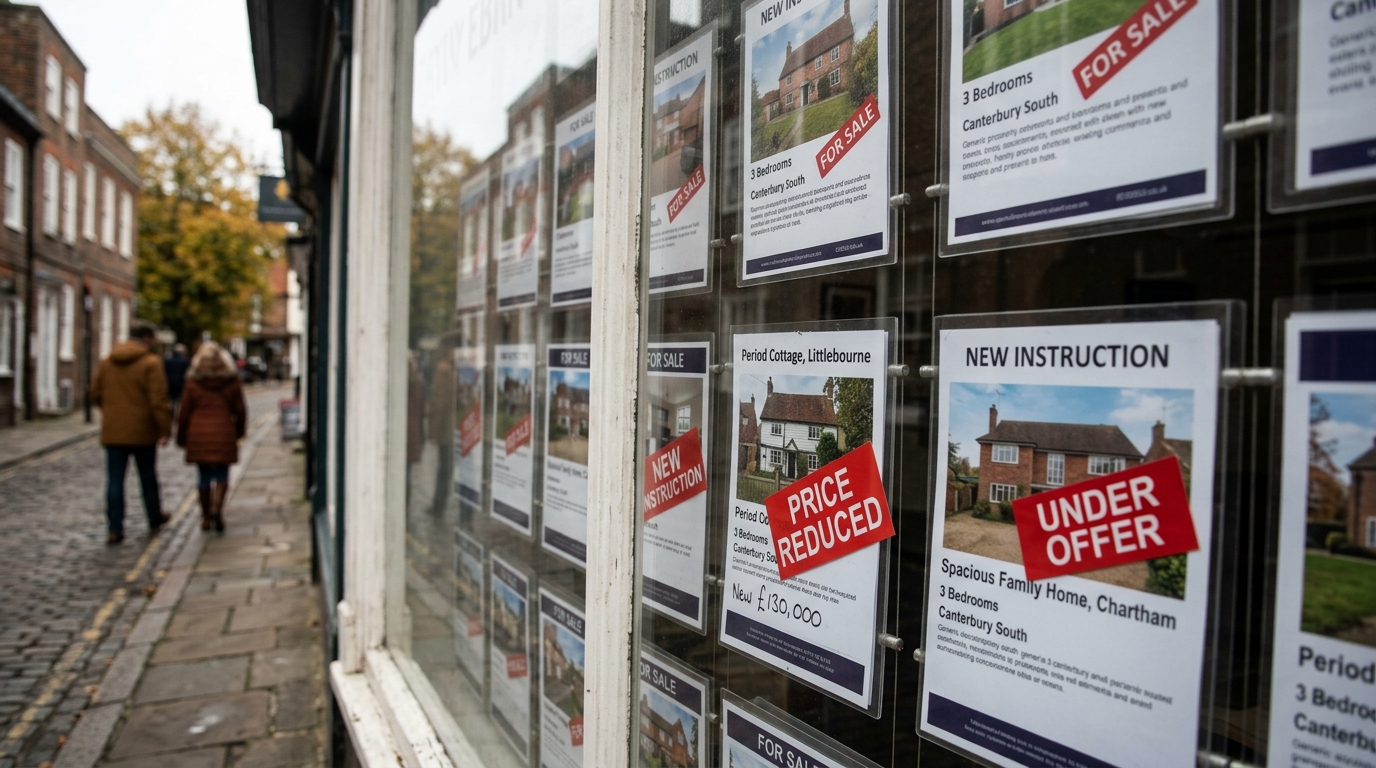
For buyers and sellers across the county, this is not an abstract argument about basis points. It is the difference between a mortgage offer that felt affordable in June and one that looks considerably tighter by September. Kent's housing market has always leaned on a particular kind of buyer, families moving out from London in search of grammar school catchments and a manageable commute, and that demand has proven remarkably sticky even through a difficult couple of years. Kent house prices fell by around 5% at the end of 2025, but that was still a noticeably softer landing than the wider South East, which dropped 7%, or England and Wales as a whole, which fell 10%. Demand near commuter stations held up better than almost anywhere else in the region, and grammar schools continue to pull buyers south from the capital regardless of what the Bank does with rates.
That resilience is being tested now. With homes across the tracked Kent areas taking an average of 188 days to find a buyer, sellers cannot afford to assume today's asking price will still look sensible in a market where mortgage rates are edging upward every few weeks. Buyers who locked in a rate a month or two ago may already be sitting on a better deal than what is available now, and that asymmetry is starting to show up in negotiations. Agents across the county report the same pattern seen nationally: serious buyers are still transacting, but they are doing so with sharper pencils and less patience for properties priced on last year's assumptions.
The Budget Shadow Lengthens
Adding to the uncertainty is the Autumn Budget, due on October 28, which will land barely six weeks after Thursday's rate decision. Buyers weighing a purchase now are having to factor in not just where mortgage rates might go, but whether the Chancellor will reach for property taxation to help balance the books. That combination, a Bank still debating whether to hold or hike, and a Budget that could reshape the cost of owning higher value homes, is exactly the sort of double uncertainty that tends to freeze decision-making rather than accelerate it.
None of this means the Kent market is in trouble. It has weathered worse than a cautious few months of rate uncertainty, and the underlying demand from London-leavers and school-run families has not gone away. But anyone expecting a swift return to the borrowing conditions of a year ago should look again at what is happening inside the Monetary Policy Committee, not just at what it announces on Thursday. The vote split, not the headline decision, is where the real signal lies. A committee moving from two dissenters to three in the space of a few months is a committee that is edging, however reluctantly, toward higher rates, and Kent's buyers and sellers will feel that shift long before any formal change to the Bank Rate itself.
The coming weeks, bridging Thursday's decision and the Budget at the end of October, look set to be the period that determines whether this autumn brings the modest recovery some had hoped for, or another stretch of the cautious standoff that has defined much of the past year.