

Nationwide's latest house price research, published this week, delivers a verdict that will surprise nobody who has ever tried to buy a cottage with a view: living somewhere beautiful still costs a great deal of money. The building society's analysis found that a property located within a national park cost 24% more on average than a similar property elsewhere, while buyers were also stumping up a 6% premium for homes within three miles of a national park. It's a headline figure, but it's the sort of headline that has held remarkably steady over time, and that consistency is arguably the more interesting story.
Scarcity by design
The mechanism behind the premium isn't mysterious. The lender said that, as well as the attractions of the beautiful countryside, restricted development in national parks meant construction of new housing was limited, which kept house prices relatively high. In other words, planning policy does a lot of the heavy lifting here. Where councils and park authorities deliberately cap new supply to protect a landscape, ordinary buyer demand runs up against a wall that developers simply cannot build through. That's a very different dynamic to most of the housing market, where sluggish price growth usually reflects weak demand rather than a hard ceiling on supply.
The numbers by park are striking on their own terms. The average property in the New Forest was £563,000, followed by the South Downs park at £485,000, and the Peak District at £450,000. Beyond the formal national parks, the same pattern shows up in England and Wales's national landscapes, the areas still commonly known by their old title of Areas of Outstanding Natural Beauty. Nationwide also found a 14% premium for properties located in the national landscapes of England and Wales, formerly known as areas of outstanding natural beauty, such as Surrey Hills and the Chilterns, with Surrey Hills the most expensive national landscape in which to buy property, with average prices of £710,000.
What makes this year's figures notable isn't the size of the premium so much as its persistence. Two years ago, Nationwide's own research found a property located within a National Park attracts a 25% premium over a similar property elsewhere, with national landscape properties commanding a comparable double-digit uplift. A premium moving from 25% to 24%, and from 15% to 14%, isn't a correction. It's a market that has essentially plateaued at a high level rather than cooling off, which tells you something about how deeply embedded these price gaps have become in buyer expectations.
Closer to home than you might think
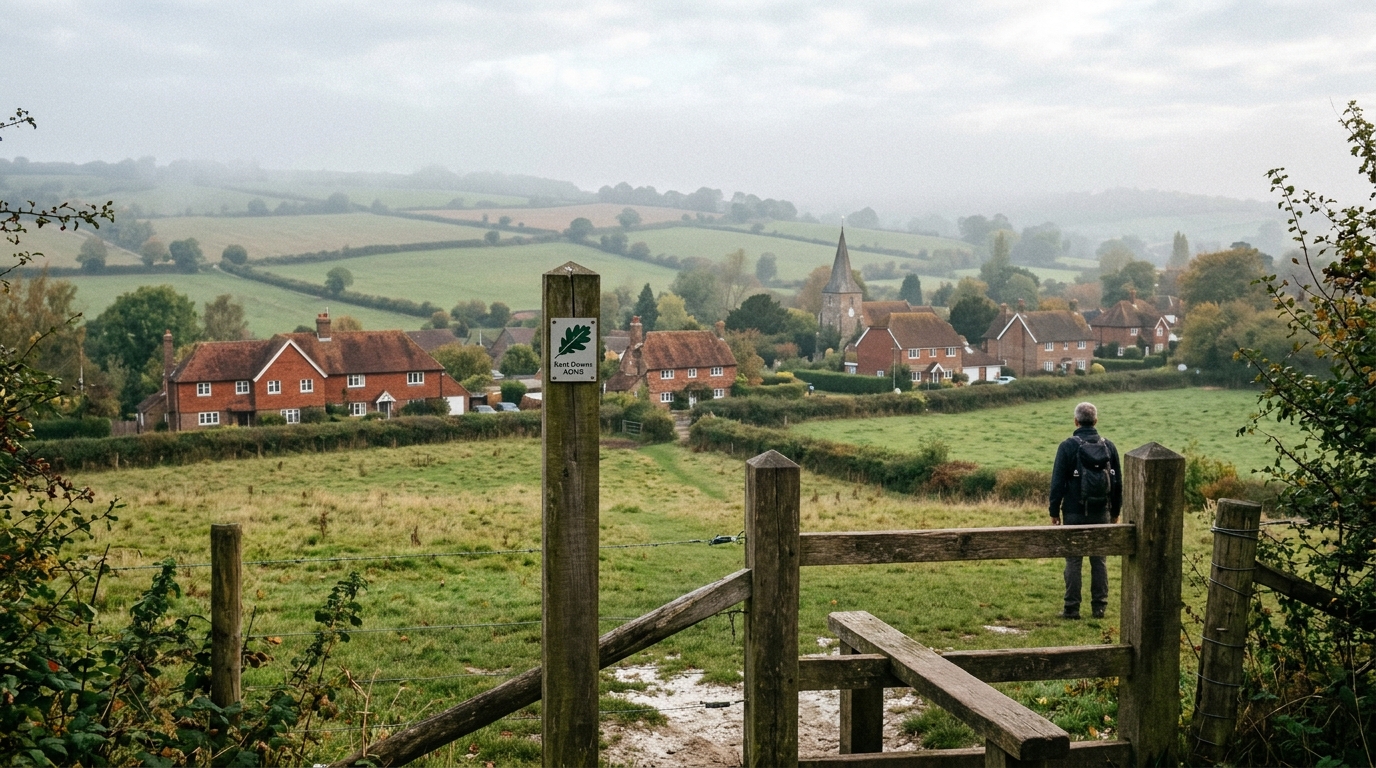
None of this is abstract for anyone selling or buying around Tonbridge. The borough of Tonbridge and Malling sits inside the boundary of not one but two protected landscapes. Kent Downs cuts through a swathe of the borough, including parishes such as Plaxtol, Shipbourne, Borough Green, Trottiscliffe, Birling, Wouldham, Aylesford, Hildenborough, Ightham, Wrotham, Ryarsh, Snodland and Burham, while a smaller pocket of the High Weald national landscape reaches in from the south, an area that falls within the borough of Tonbridge and Malling to the south of Tonbridge. That means a meaningful share of the borough's housing stock sits inside, or right on the fringe of, exactly the kind of designated countryside Nationwide's research is describing.
Nationwide's own published figures put the average house price within the Kent Downs national landscape at £449,000, based on the building society's most recent breakdown of premium areas across England and Wales. That sits well below the eye-watering Surrey Hills figure of £710,000, but it still reflects the same underlying story: tight development control, finite supply, and a countryside pull that buyers are prepared to pay for. For agents working villages on the Kent Downs fringe, that number is a useful anchor point when a seller asks why their period cottage in a protected parish should be priced differently to a similar house on the edge of town.
Tonbridge itself, of course, isn't a national landscape and its property market behaves according to its own logic, one shaped more by commuter rail links, school catchments and the pull of the Weald towns than by planning restrictions on new housebuilding. Average prices across our tracked local area currently sit at £883,309, a figure that has barely moved over the past year, up just 0.0% year on year. Properties are taking an average of 182 days to find a buyer, and only around 30% of listings have gone under offer, a sold subject to contract rate that points to a market where buyers are taking their time and sellers are having to work harder to secure a deal.
That contrast is instructive. Nationwide's research shows landscape-protected areas holding firm on price because supply is artificially constrained. Tonbridge's own figures suggest a market that is essentially flat not because of restricted supply, but because buyer confidence and mortgage affordability are doing more of the work in setting the pace. Two very different forces, arguably, producing two very different outcomes, one a stubbornly high floor under prices, the other a long, patient stand-off between asking prices and what buyers are actually willing to commit to.
What it means for sellers near the boundary
For anyone with a property inside, or close to, the Kent Downs or High Weald boundary, the lesson from this research is fairly direct. Designation status is not just a planning technicality, it is a genuine, measurable driver of value, and one that has proved unusually resistant to the wider market's mood swings. A seller in Hildenborough or one of the Kent Downs parishes may find that the usual arguments about a slow, 182 day average market apply rather less forcefully to their own listing than to a comparable home a few miles away outside the boundary.
Buyers, for their part, should go in with open eyes. The same scarcity that protects value against downturns also means less choice, more competition for the right property, and negotiations that can move at a different pace to the rest of the local market. Nationwide's figures on the fringe premium are a reminder that this effect doesn't stop dead at a park boundary line either. Homes within three miles of a national park, and by extension those close to a national landscape boundary, still carry some of that same pulling power, even without the formal designation attached to the title deeds.
A landscape effect that isn't going away
What this year's Nationwide research really confirms is that the appeal of protected countryside is not a passing pandemic-era fashion. It has held up, premium for premium, across several years of data now, through periods of rapid price growth and through periods, like the present one locally, of near total stagnation. For a town like Tonbridge, sitting with one foot in the Kent Downs and another brushing the High Weald, that's not a footnote. It's a structural feature of the local market that sellers, buyers and agents alike would do well to keep factoring into every conversation about value, well beyond whatever the headline market figures happen to say in any given month.