
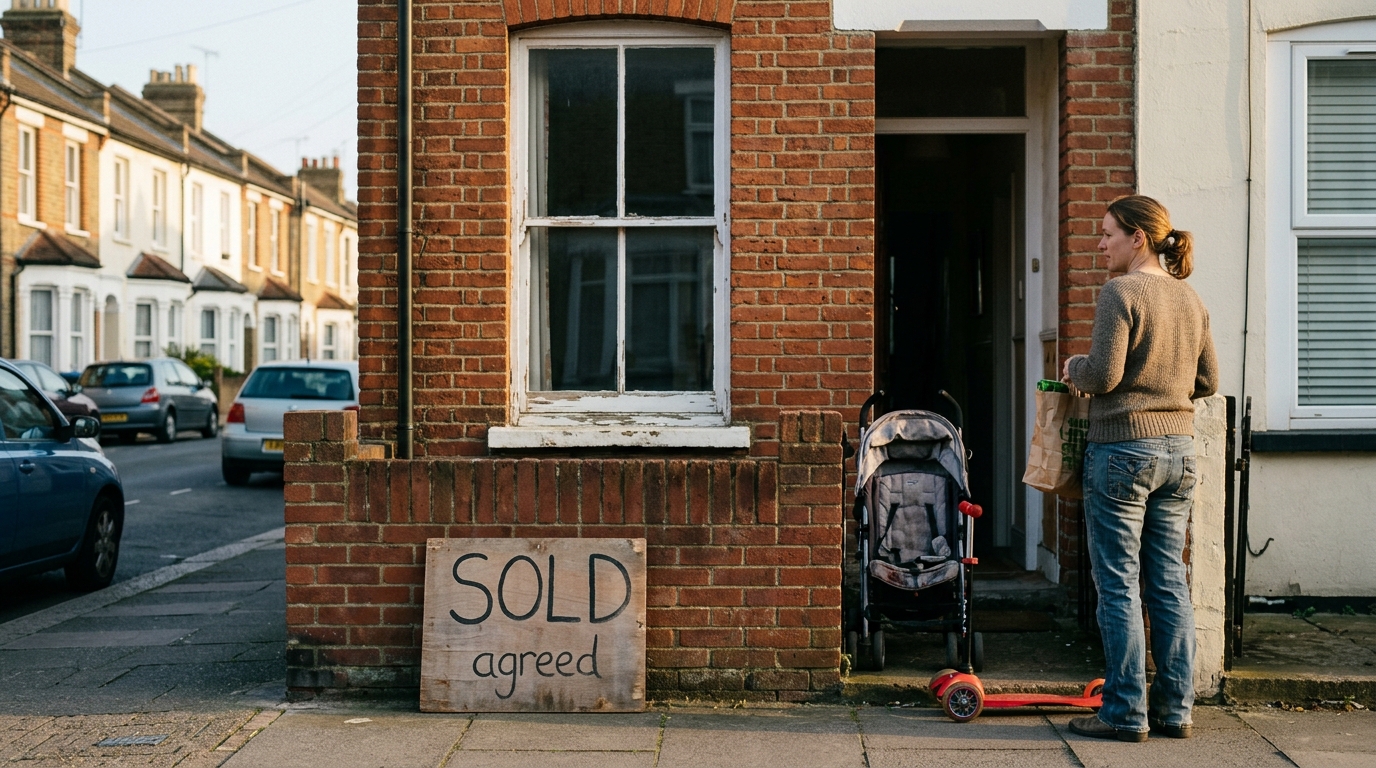

The Guardian's Saturday opinion page carried something unusual this week: not a column, not a leader article, but a cartoon. Stephen Ashman's illustration, published on 19 September, takes aim at the difficulties facing first-time homebuyers. Cartoons rarely make property news in their own right, but this one lands at a moment when the reality it satirises is being documented, in cold figures, across the industry press almost weekly.
That timing matters. A single drawing can say what several thousand words of analysis sometimes cannot, and the fact that a national newspaper chose this subject for its weekend satire tells you something about how mainstream the grievance has become. First-time buyers are no longer a niche concern for housing charities. They are the subject of boardroom commentary from Britain's biggest housebuilders.
A market that housebuilders themselves call brutal
Young people trying to buy their first home in the UK are facing the toughest market conditions since the financial crisis, according to the head of the country's biggest housebuilder. Barratt Redrow chief executive David Thomas pointed to a combination of rising mortgage rates, growing student debt and pressure on wages making things increasingly difficult. That is not a campaigning charity or an opposition politician talking. That is the boss of a company whose entire commercial model depends on first-time buyers actually buying.
The numbers back him up. Property platform Zoopla found there are 6 per cent fewer first-time buyers in the market compared with a year ago. Fewer buyers at the bottom of the ladder eventually means fewer sales further up it too, because chains depend on that first rung holding.
Older, later, and starting families before they start owning
What the cartoon captures visually, the demographic data confirms numerically. Figures reported by the Financial Times show that the average UK first-time buyer is now approaching 34, compared with 29 in 2000, while almost one in three has children before buying, up from around one in four in 2020. That is a genuinely significant shift in the shape of a household's life. Buying a first home used to be the thing you did before children arrived. Increasingly, it is something that happens after.
This changes what people need from a property, not just when they can afford one. A young couple without children searching for a one-bedroom flat has very different requirements from a family of four trying to buy their first home while juggling nursery fees and school catchment areas. Estate agents up and down the country are seeing this shift in the questions buyers ask at viewings.
The deposit wall has not moved
Ask most prospective buyers what stops them, and the answer has not changed in years. Rightmove's property expert has said the biggest obstacle for many first-time buyers is still saving a deposit, though once that is in place, the picture is becoming more encouraging. Buyers currently have a wide choice of homes, affordability conditions have improved thanks to lenders changing their affordability criteria, and wages have grown faster than house prices in many parts of the country.
That last point is a genuinely useful nuance, and one worth holding onto. It is not that every first-time buyer is being squeezed harder every single month. It is that the initial hurdle of raising a deposit remains stubbornly high even as some of the running costs beyond it ease slightly. Research from Skipton has found that just one in eight potential first-time buyers can buy a home in their local area, and of that same group, 80 per cent have insufficient deposit savings to get onto the property ladder where they live. The typical first-time buyer deposit sits at around £61,090, roughly a fifth of the purchase price, according to analysis of Halifax data by the HomeOwners Alliance.
Kent's own version of the gap
None of this is an abstract national argument when you look at what buyers here in Kent are actually facing. Across the areas we track locally, the average asking price sits at £877,842. Compare that with the national first-time buyer average house price, which stood at £226,000 in January this year, and the scale of the gap becomes obvious. Kent has always attracted buyers priced out of London, but that migration only works if the arithmetic still adds up for someone taking their first step onto the ladder rather than their third or fourth.
Regionally, the picture is consistent with what national data shows for the South East more broadly. The second highest prices for first-time buyers can be found in the South East of England, with the average house price at £299,000. That already sits well above the national first-time buyer figure. Add Kent's premium commuter towns and coastal spots that have gentrified over the past decade, and the deposit required locally can be a multiple of what a buyer in the North East or Scotland would need to find.
Leasehold flats add another complication
There is a further wrinkle that the cartoon's broader theme touches on without naming directly: the type of property first-time buyers are actually willing to consider. Data suggests 80 per cent of leasehold flats on the market in England during 2025 failed to sell within six months. Contributing factors include service charges, leasehold complexity, mortgageability and differences between seller and buyer expectations. For a generation of buyers already stretched by deposit requirements, an added layer of leasehold uncertainty is proving to be the last straw rather than an acceptable compromise. Many are simply walking away from flats altogether and holding out for houses, even if that means waiting longer.
What the cartoon gets right
Satire works best when it compresses a complicated, slow-moving problem into a single image that people recognise instantly. Ashman's cartoon does exactly that. It does not need a footnote explaining mortgage stress tests or loan-to-value ratios, because the underlying frustration, of working hard, saving diligently, and still finding the door to home ownership held shut, is something a huge number of readers will feel in their gut before they read a single statistic.
The industry data simply confirms what the cartoon implies. First-time buyers are getting older. They are increasingly starting families before they own a home rather than after. Deposits remain the single biggest barrier, even where monthly affordability has eased slightly. And in expensive corners of the country, including much of Kent, the gap between what a typical first-time buyer can afford and what is actually on the market has not meaningfully closed.
Where this leaves buyers now
There is no single policy lever that fixes this overnight, and anyone promising one deserves scepticism. What seems more likely over the coming months is a continuation of the pattern already visible: modest improvements in mortgage affordability criteria, wages in some regions edging ahead of house price growth, and buyers adapting by widening their search areas, reconsidering property types, or simply waiting longer before they take that first step. The cartoon captured a moment of shared exasperation. The task now, for lenders, housebuilders and local agents alike, is making sure that exasperation does not calcify into a generation who give up on the idea of owning a home at all.