
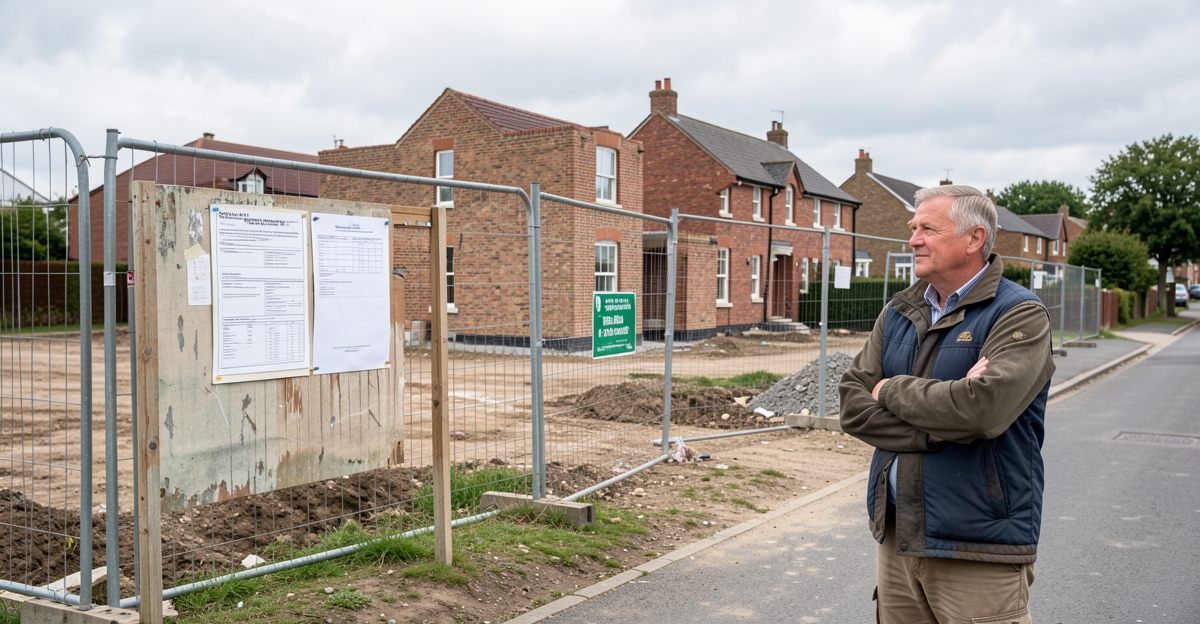

A fundamental change to who decides what gets built
Mayors across England are to be given new powers to overrule local councils on major planning decisions, in a move that represents the most significant shake-up of the English planning system in years. Mayors across England will be given new powers to overrule local councils on some planning decisions, with the change applying to proposals with more than 150 homes, more than 15,000 square metres of commercial space or buildings over 30 metres. The announcement, made on 23 August 2026, was cross-examined across every major newsdesk within hours. It matters to anyone who owns property, is trying to buy one, or is waiting for a new development to unlock supply in their area.
The changes will give elected mayors in 13 combined authority areas powers similar to those already held by London Mayor Sir Sadiq Khan, allowing them to "call in" major planning applications for their own consideration rather than leaving decisions entirely in the hands of local councils. The move has been backed by ten mayors from different parties.
What "call-in" actually means in practice
The language of "call-in" can sound bureaucratic, so it's worth being direct about what it actually allows. Under proposals to be published next week, a mayor will now be able to take over key planning applications which impact on local growth, and direct a council to take it forward or refuse it. That is a real transfer of decision-making authority - not a vague advisory role. And there's a second, potentially more consequential power alongside it.
Mayors will also be able to grant up-front permission for development, so that building can begin without a developer having to apply. Think about what that means for the pace of housebuilding. A scheme that might have spent years in planning limbo could, in theory, be green-lit at mayoral level before a single application form is filed. The move would see mayors allowed to direct councils to take decisions forward or refuse them, and they would also be able to grant upfront permission so developers can start building without having to apply.
The government has already set out a broader push to hand more powers, funding and responsibility to English mayors. Under that plan, mayors will keep a share of income tax and business rates revenues, part of what ministers have called the biggest transfer of power from Westminster in a generation. The planning announcement is one piece of that far larger devolution agenda.
The government's case - and the political friction
Housing minister Matthew Pennycook said the powers were an "essential part of the toolkit that mayors need to effectively deliver new homes and regeneration." The government is candid about the stakes. In the 2024 general election, the Labour government promised to build 1.5 million homes in England by the end of the decade, but housebuilders have warned the target could be missed. Pennycook described the target as "really stretching" but argued that nearly 180,000 children are currently living in temporary accommodation, making the need for additional housing particularly urgent.
The government is just over a quarter of the way to its target to build 1.5 million homes in England in five years. That gap is vast. Prime Minister Andy Burnham, who served as mayor for Greater Manchester for nearly a decade before entering Downing Street, has been the driving force behind the mayoral devolution agenda. The proposals are part of Burnham's devolution programme, which he believes will drive growth up and down the country. The Prime Minister hopes this will help power his goal of building the largest number of council houses since the Second World War.
Not everyone is convinced. Shadow Housing Secretary Sir James Cleverly stated that the government was "simultaneously stripping councils across the country of their ability to make planning decisions in their own communities." The Liberal Democrats said the move was a "direct attack" that would silence residents. Gideon Amos, the party's housing and planning spokesperson, said: "Taking powers away from communities and local councillors is taking powers away from local people." Even some mayors are wary. Paul Bristow, the Conservative mayor of Cambridgeshire and Peterborough, told the BBC that if he had the new powers he would approve blocked schemes straight away, but stressed the intention is to prompt better compromise between developers and councils - not simply bulldoze local objection.
London as a test case - and a complicated one
Advocates of the change point to London as proof of concept. Housebuilding has fallen in London in recent years, but Pennycook insisted the "call-in" powers had helped the mayor "unblock strategic growth sites" in the capital. The powers bring the new mayors into line with Mayor of London Sadiq Khan, who was already given the powers earlier this year in an emergency measure aimed at unblocking dozens of stalled sites in the capital.
The London precedent is instructive but imperfect. Housebuilding in the capital fell even as mayoral call-in powers existed, which suggests the tool alone is not enough. Supply constraints, land values, infrastructure costs, and viability all shape whether homes actually get built once permission is granted. What the power does is remove one specific blocker - the refusal by a local council that a mayor believes is acting against strategic interests. Whether that translates to meaningful completions at scale is a question the next few years will answer.
Where Tonbridge stands - and why the geography of this reform matters
Here's the part that matters most to anyone buying, selling, or investing in Tonbridge and the surrounding area of Kent. This reform covers mayoral combined authority areas. Tonbridge sits in Kent, outside any of the 13 combined authority areas named in the announcement. The powers will be available to mayors in the Combined Authorities in North East England, South Yorkshire, West Yorkshire, York and North Yorkshire, Hull and East Yorkshire, Greater Lincolnshire, Cambridgeshire and Peterborough, East Midlands, and Tees Valley - as well as the areas already listed including Manchester and Liverpool. Kent is not among them.
That means Tonbridge's planning decisions remain with Tonbridge and Malling Borough Council and the broader county planning framework - for now. The government has sought to stress that local councils will continue to decide the majority of applications and that all decisions must still follow planning rules. For buyers and sellers here, that continuity has real consequences.
Our own data across 12 local areas paints a picture of a market that has reached something of a plateau. Average prices stand at £719,483, with year-on-year price change at 0.0% - flat, but not falling. Properties are averaging 457 days on market, and the sold subject to contract rate sits at 20%. These are the numbers of a market waiting for a catalyst: not distressed, not booming, but patient. The flat pricing reflects what one might expect when mortgage affordability has been under pressure and supply has been constrained but not decisively unlocked.
There are increasingly more grey belt decisions coming through in Kent which would not have done so without National Planning Policy Framework changes. Kent's first grey belt planning success saw the Planning Inspectorate grant permission for 57 new homes on former horticultural land on the edge of Hadlow near Tonbridge. That's incremental progress - welcome, but a long way from the step-change that the mayoral call-in powers are designed to deliver in urban combined authority areas.
Several schemes in Tonbridge involve converting parts of shopping centres to residential, alongside other schemes across Maidstone, Thanet, Dartford, and Sevenoaks providing housing on mainly council-owned sites. This kind of brownfield and town-centre conversion is where much of Tonbridge's near-term supply is likely to come from - driven by the existing planning framework rather than any new mayoral override power.
What to watch for next
A consultation will be published next week that will set out exactly how the new mayoral planning powers will work in practice. The detail will matter enormously - particularly whether the threshold criteria shift over time, and whether a future government might extend the mayoral model beyond the current 13 combined authority areas. If devolution continues its current trajectory, it's not unreasonable to suppose that Kent could eventually fall within a structure that brings these kinds of powers closer to home.
For buyers and vendors in Tonbridge right now, the immediate reality is a market defined by steadiness rather than surge. Prices have held, but the 457-day average time on market tells its own story: stock is moving slowly, and buyers have time to be selective. The national conversation about unlocking planning, accelerating housebuilding, and devolving power to regional leaders is a critical backdrop - even if the specific policy announced this week doesn't touch Kent directly. What it does signal is a political consensus that the status quo on housing supply is no longer acceptable, and that future reform is more likely to expand than contract. That's a medium-term consideration worth keeping in mind for anyone making a long-term property decision in this part of the world.