
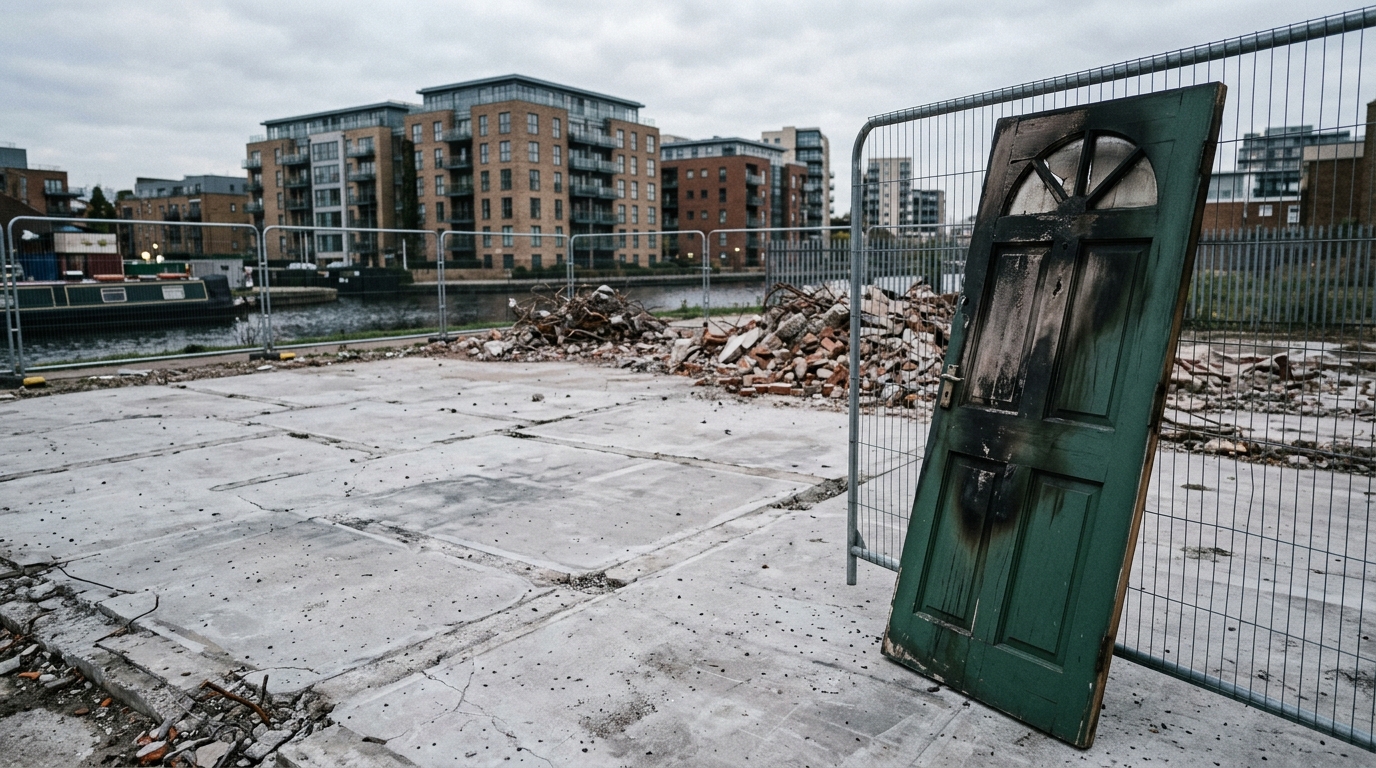

Two years ago this week, a fire tore through the Spectrum Building on Freshwater Road in Dagenham, east London, in the early hours of the morning. More than 80 people were made homeless when the blaze ripped through the seven-storey mixed-use block. The building doesn't exist any more. It was demolished in December 2024. What does still exist, painfully and absurdly, are the mortgages. The monthly direct debits. The financial obligations attached to homes that are now, literally, rubble.
That is the story the Guardian is telling today on the fire's second anniversary, and it deserves far more attention than it has received.
How a Building Burns Twice
The cruel irony at the heart of this case is that the Spectrum Building caught fire precisely because someone was trying to make it safe. When the fire broke out, remediation work was underway to remove non-compliant cladding from the block, with scaffolding covering parts of the building. A London Fire Brigade internal report found it was the scaffolding put in place to remove the cladding that "assisted the fire's spread up the building."
The building's history is a near-perfect catalogue of everything that has gone wrong in the post-Grenfell era. It began life as the offices of chemicals company DuPont when it was built in 1974, before being converted to 60 residential apartments, along with a gym and a nursery. In September 2020, three and a half years after the Grenfell Tower fire, an External Wall System survey was completed on the building. According to evidence given by the Spectrum Residents' Association to a parliamentary inquiry in February 2022, that survey showed the building did not fully comply with building regulations at the time of build.
Residents told parliament they had been fighting for the property to be made safe, describing "the stress on leaseholders living in unsafe, unsellable flats with increasing service charges for well over three years" as "considerable." Work to actually fix the cladding didn't begin until February 2024. Six months later, the building was gone.
In April 2023, the London Fire Brigade had issued an enforcement notice to Block Management UK, the management company for the building, urging it to review its fire risk assessment and emergency plan and implement preventative measures. Charlie Pugsley, a deputy commissioner of the London Fire Brigade, described the blaze as "one of the most extreme fires we have seen in a residential block in recent years."
The Freeholder Goes Under, the Leaseholders Stay Stuck
The building's freeholder, Arinium Ltd, went bankrupt shortly after the fire. Since the fire in August 2024, the building's freeholder has gone into administration. The administrators are now in control of the money, including insurance proceeds, and it is the administrator's responsibility to pay these funds out to former residents to cover losses and damages caused by the fire. Two years on, that money has not been paid out. Nobody knows exactly how much will be available, or whether it will even cover the value of the flats that were destroyed.
Sarah Williams, one of the leaseholders, camped overnight in a car park in 2016 to put down a deposit on her flat when it first went on sale - one of the many Londoners for whom a new-build leasehold apartment was the only realistic route onto the property ladder. Four years after buying, her flat became unsellable because of the dangerous cladding. Another four years, and it had burned down. "We still haven't got our money, and we have no idea whether it will even cover the value of the flats," she told the Guardian. "We've still got to pay our mortgages. We've still got to pay our rent."
Emergency accommodation funded through insurance is covering residents for three years from the date of the fire. No one knows what happens if the compensation process hasn't concluded by then - leaving some people facing the prospect of simultaneously paying rent, a mortgage, and getting nothing back.
Through its Building Safety Fund, the government granted £5.9 million for remediation at the Spectrum Building, which was still taking place at the time of the fire. The full funding was approved in July 2023, and works started on site in December 2023. As part of the legal process of formally closing the Building Safety Fund project, the Greater London Authority informed the administrators of its interest as a potential creditor in the administration - described by government as a technical, procedural step standard in insolvency law. The government has stated that its position as a creditor will have no impact on the money residents are owed, and that it would only be due any funds if there is money left over after residents have been fully compensated.
A group of 17 MPs has written to building freeholder Arinium and insurer Aviva, urging them to provide information about what "caused the fire and what allowed it to spread so quickly." A London Fire Brigade investigation was unable to find a cause of the blaze. The HSE criminal investigation remains ongoing.
A Systemic Problem, Not an Isolated Tragedy
It would be convenient to treat the Spectrum Building as an outlier - an extreme and unusual case that doesn't speak to anything broader. It isn't. The combination of factors that trapped these leaseholders, dangerous cladding, an absent freeholder, an unresolved insurance claim, an unsellable flat, and a mortgage that keeps running regardless, represents a concentrated version of risks that are dispersed across tens of thousands of properties nationwide.
The cladding crisis has left thousands of homeowners grappling with unsellable properties and mounting financial challenges, including difficulties in renewing mortgages and additional costs from increased service charges to cover fire safety measures. Analysis of the leasehold flat market found that an average of 80.5% of leasehold flats listed during 2025 across areas studied had not sold within six months. London was the weakest market, where approximately 87% remained unsold after six months, followed by the South East at 85%.
The numbers are not academic. Harry Scoffin, of campaign group Free Leaseholders, told a parliamentary committee: "There is a crisis in the flats market at the moment. People cannot sell. They cannot move on." The warning followed research suggesting that 37% of flats have a service charge equivalent to 1% of the property price. Lenders will often restrict or refuse mortgages on flats with high service charges, and as Scoffin put it: "What that means is those flats are unmortgageable. They are unsellable."
The Leasehold and Freehold Reform Act is now law, but is far from being fully implemented, and amid this uncertainty some buyers are holding off buying leasehold properties. More critically, leaseholders are still awaiting meaningful regulation of service charges - arguably the most significant barrier to property sales.
What This Means for the Tonbridge Market
Here in Tonbridge and the surrounding Kent commuter belt, the cladding story plays out differently to Dagenham, but it's not entirely separate either. The market here is dominated by family houses rather than the kind of high-rise leasehold flats at the centre of the Spectrum case. That insulates our local buyers and sellers from the very worst of what Sarah Williams and her neighbours have experienced.
But insulated is not the same as immune. A significant proportion of flats across the south-east sit in buildings that have either required or are currently undergoing cladding remediation. The South East as a region recorded 85% of leasehold flats unsold after six months in 2025, and buyers who can't sell a flat can't use the proceeds to buy a house. When the flat market seizes up, chains stall, and the effects ripple upwards through all property types and price points.
New research covering more than 2,000 buildings in remediation programmes in England and Wales shows that insurance rates remain higher where flammable cladding or other external defects are present. For leaseholders in affected buildings, that means higher service charges, which in turn feed through to reduced mortgageability, reduced buyer pools, and reduced prices. The domino effect is real and well-documented.
For anyone in and around Tonbridge currently buying or selling a flat, the practical lesson from the Spectrum case is straightforward: know your building's cladding status before you proceed, check what EWS1 certification your lender requires, and take specialist advice if there's any ambiguity. Lenders can consider applications on cladding-affected buildings if the building is covered by a recognised remediation scheme or if Building Safety Act leaseholder protections apply - but criteria vary greatly between lenders. The paperwork matters enormously.
The Longer View
The Spectrum Building fire didn't just destroy 80 homes. It exposed, in the starkest possible terms, the gap between legal protection on paper and financial relief in practice. The Building Safety Act offers qualifying leaseholders protections that, a few years ago, didn't exist. But as the residents of Freshwater Road have learned, protection from remediation costs doesn't help much when there is no building left to remediate, when the freeholder has collapsed, and when the insurance money sits locked inside an administration process that moves at its own pace while mortgages fall due every month.
The lack of fatalities in the Spectrum fire, while clearly a huge relief, means the disaster hasn't captured the attention or outrage that Grenfell did. But as with the fatal cladding fire at Lakanal House in Camberwell eight years before Grenfell, there is a danger that lessons could go unlearned. The second anniversary of the fire is a reasonable moment to ask whether they have been.
For anyone watching the property market, the broader trajectory is clear enough. Buyers are increasingly sophisticated about leasehold risk. The flat market in many parts of England is structurally impaired in ways that won't be resolved quickly. The government's 2029 target for completing all cladding remediation work is at least a deadline, but it's three years away, and in the meantime the human cost keeps accumulating, one monthly mortgage payment at a time.