
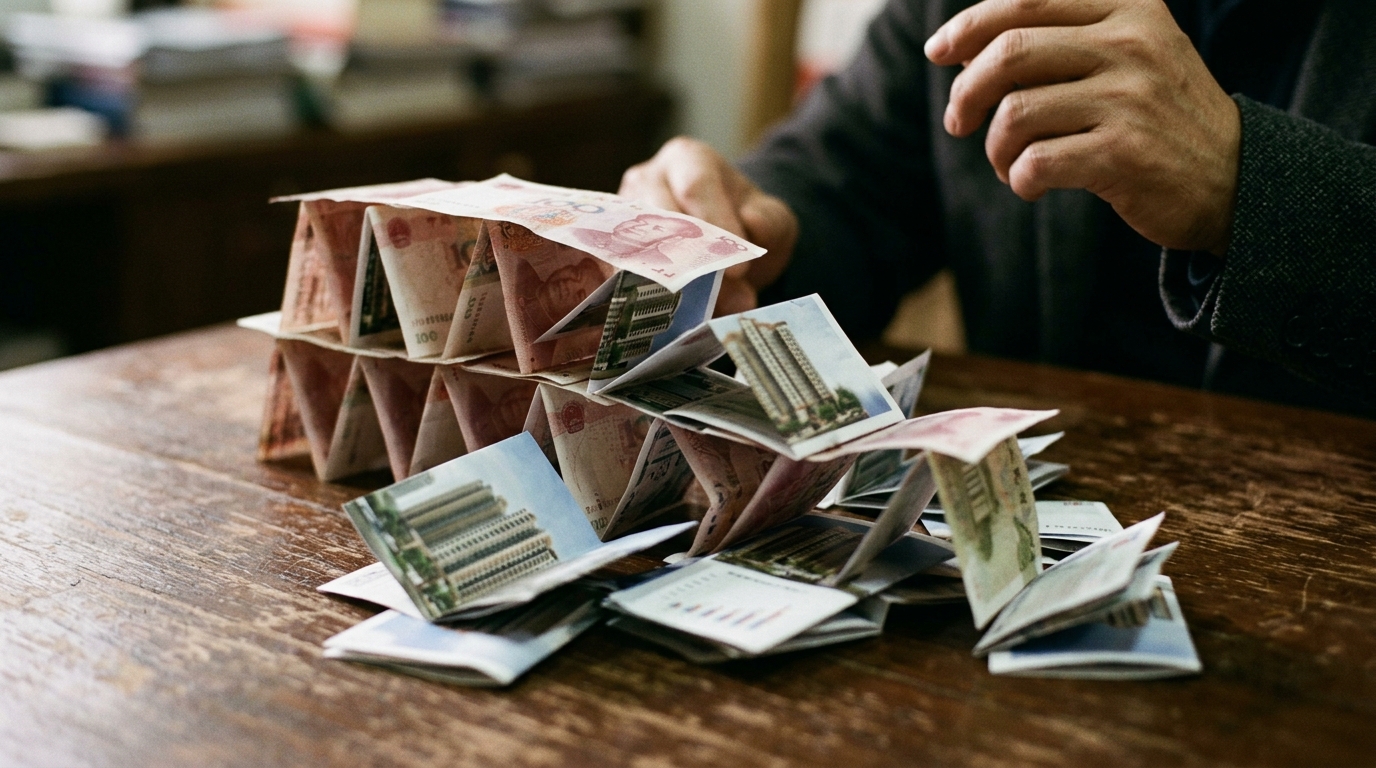

The Verdict That Shook a Sector
Hui Ka Yan is going to prison for the rest of his life. The founder of Evergrande, once the world's most indebted property developer, was sentenced by the Shenzhen Intermediate People's Court on 20 August 2026 for a catalogue of financial crimes that reads like a masterclass in corporate recklessness. He was convicted on charges including illegal absorption of public deposits, fundraising fraud, illegal lending, fraudulent issuance of securities, failure to disclose material information, embezzlement and bribery. The court also stripped Hui of his political rights for life and ordered the confiscation of all his personal assets.
The scale of the punishment matches the scale of the wreckage. Hui Ka Yan, 67, was convicted in the southern city of Shenzhen, and the companies were fined a total of more than $2.3 billion for financial crimes, including inflating the group's assets and concealing liabilities that ran to more than $300 billion. He was sentenced alongside 56 others involved in Evergrande, including his sons Xu Zhijian and Xu Tenghe. A total of more than 50 individuals were sentenced to imprisonment of between 22 months and 18 years.
"The amount involved is exceptionally large, the circumstances are particularly egregious, and extraordinarily heavy economic losses have been caused," the court wrote in its statement. It is difficult to argue with that assessment.
The Rise Before the Fall
The sentencing brings an end to one of the most dramatic rise and fall stories in China's corporate history. Hui grew up in rural China, raised by his grandmother, before setting up Evergrande in 1996. What he built over the following two decades was extraordinary - and extraordinarily fragile.
At its height, Evergrande had about 200,000 employees, raked in more than $110 billion in sales and owned more than 1,300 developments in more than 280 cities. The company became China's biggest real estate developer, with a stock market valuation of more than $50 billion, and Hui was once estimated to be Asia's richest person. That wealth was built on borrowed money, borrowed time, and - as the court has now confirmed - borrowed credibility.
He was convicted of overseeing Evergrande as it engaged in large-scale financial fraud, inflating the group's assets while concealing its liabilities. Tactics used included prematurely booking revenue from property sales before completion and delivery of apartments to buyers. Revenues were overstated by roughly $80 billion over 2019 and 2020. That is not an accounting error. That is a calculated deception on a breathtaking scale.
The company's crisis partly stemmed from the introduction of Beijing's "three red lines" rule in 2020, which made it harder for developers to seek bank financing to fund their projects. Suddenly the music stopped. Evergrande could no longer keep borrowing to paper over its debts, and the whole structure began to buckle.
The Collapse and Its Consequences
The decision marks a milestone in Evergrande's saga after it defaulted on more than $300 billion in liabilities when Chinese authorities cracked down on excessive borrowing in the real estate industry in 2020. That triggered a crunch among many developers and brought on a downturn in the property market that has weighed on the broader economy ever since.
The human cost has been enormous. The company took millions of dollars in pre-sale funding from homebuyers that was not used for construction. Instead, that money was channelled into new developments, leaving hundreds of projects unfinished and hundreds of thousands of families without the homes they had paid for. The collapse had a domino effect, as over 50 developers faced a similar outcome due to failure to meet debt repayments.
Property prices in China have not recovered. From their peak in 2021, housing prices have dropped by 35%. New home sales in China dipped to their lowest value since 2014, totalling only 7.3 trillion yuan ($1.06 trillion), versus 16.2 trillion yuan ($2.3 trillion) in 2021, at the height of the boom. That is a halving of the market. A whole sector that once felt permanent and ever-growing has been exposed as deeply vulnerable to the same forces - debt, over-supply, speculative excess - that have brought property markets to their knees throughout history.
Real estate and related industries used to account for as much as 30% of GDP in China. The collapse of one company did not just wipe out shareholders. It damaged local government finances, eroded consumer confidence, and cast a long shadow over the world's second-largest economy.
Why This Matters to UK Buyers and Sellers
For anyone sitting in Tonbridge right now wondering whether any of this affects their move, the honest answer is: indirectly, yes - and more than most people realise.
Evergrande's crisis, along with those of other Chinese property giants, has been at the heart of a wider real-estate shock that has tested the world's second-largest economy and at one point threatened to spark a contagion effect that would roil global markets. That contagion, while ultimately contained, forced central banks and institutional investors around the world to reassess how they priced risk. The UK did not escape that reassessment. Global credit conditions tightened, risk appetite contracted, and the cost of borrowing - which flows directly into mortgage rates - was affected by what happened in Shenzhen just as much as by what happened in Threadneedle Street.
Many Chinese homeowners feel poorer and are not spending as much as before. Retail sales, used as a proxy for consumption, grew at just 3.7% - slower than pre-pandemic levels of 7% to 8% - and this has a ripple effect on the Chinese and global economy. A sluggish Chinese consumer means slower global growth, which in turn shapes the economic backdrop against which UK buyers and sellers make their decisions.
There is another thread worth pulling. An eventual oversupply of housing led to whole ghost districts and empty projects in many places across China. That is an extreme version of what happens when supply dramatically outstrips genuine demand - a cautionary tale for any market that mistakes momentum for fundamentals. The Tonbridge area, with its attractive commuter position and constrained land supply, sits at the opposite end of that spectrum. But the lesson from China is that no market is immune to the consequences of debt-fuelled speculation, wherever in the world it originates.
In 2026, the Chinese property market is undergoing a structural shift from speculative hyper-growth into a permanent "stable contraction". That structural shift has real consequences for global trade, for capital flows into the UK, and for the macro-economic conditions that shape mortgage pricing here.
A Closing Chapter, Not a Clean Slate
The life sentence handed to Hui Ka Yan is, in one sense, closure. The disgraced property tycoon, once Asia's second richest man, had turned Evergrande into a poster child of corporate excess during China's long real estate boom. But after his empire came crashing down following a 2021 default, he was caught in a dragnet of official investigations that ultimately caused his downfall. The court's verdict closes the personal chapter. The economic chapter is still being written.
Beijing has issued many measures over the past several years to stabilise the property market, and there is no end to the crisis in sight. That is a sobering line from a CNN report published today - and it deserves to be taken seriously. The sentencing of Hui does not restore the unfinished apartments, does not return the savings of the homebuyers who were defrauded, and does not repair the confidence of a Chinese consumer who watched the sector collapse around them.
For property markets in places like Tonbridge, the relevance of all this is not dramatic or immediate. It is quieter and more structural. A China that is economically weaker, whose consumers are more cautious, and whose property sector is contracting rather than expanding, is a China that exerts a different gravitational pull on global growth. That pull shapes the interest rate environment, the investment climate, and ultimately the confidence of the buyers and sellers who walk through our doors every day.
The most important thing the Evergrande story tells us is not what happened in Shenzhen. It is what can happen anywhere when debt is mistaken for wealth, when revenue is overstated to keep a story alive, and when the fundamentals of a market are allowed to drift too far from reality. Those lessons do not carry a postcode. They apply everywhere.