
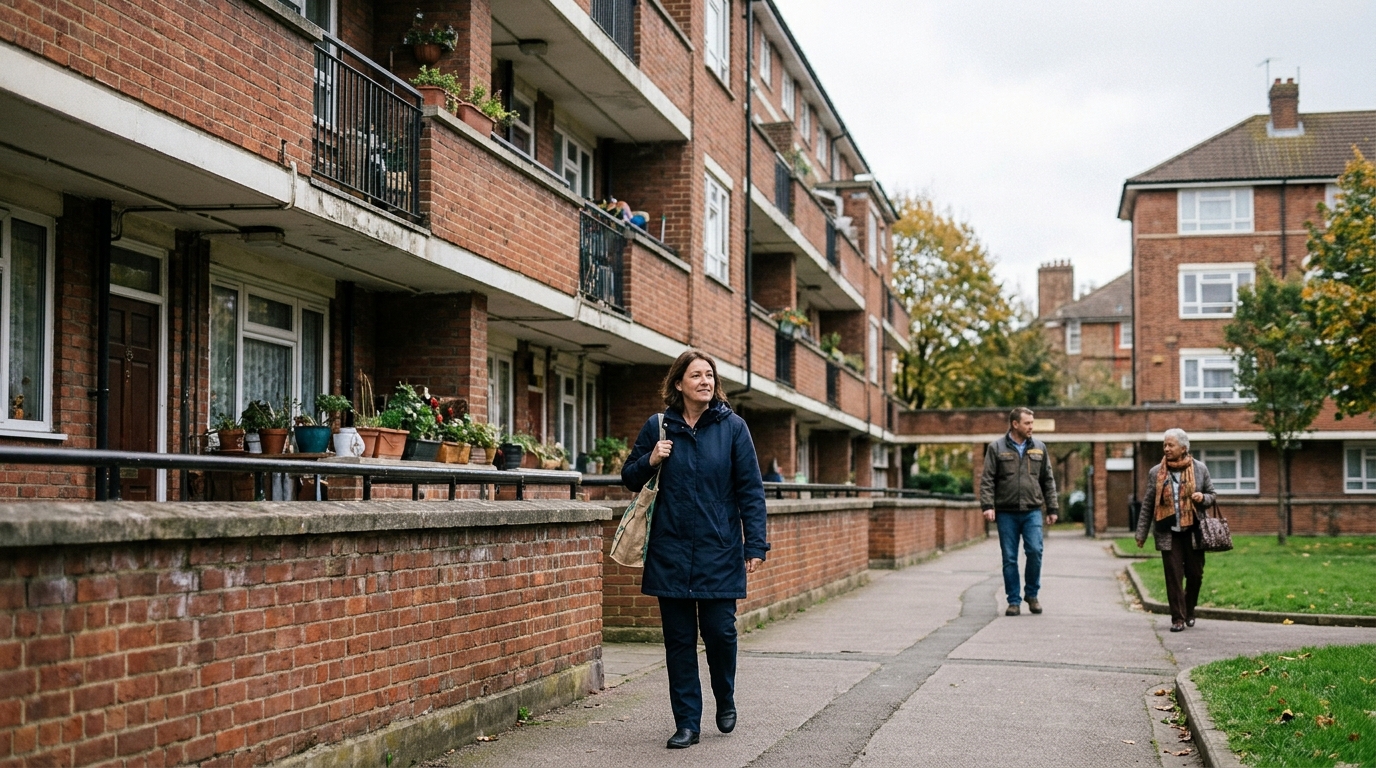

Domestic abusers will face direct eviction from social homes while survivors retain their tenancy under new legislative measures tabled for the Social Housing Bill. The move removes a long-standing legal trap that forced individuals fleeing violence to sacrifice their secure tenancies, uproot their families, and enter temporary accommodation.
Ministers confirmed the amendment will prevent survivors from having to prove abuse again in court where an existing protection order is already established. By addressing the structural vulnerabilities of joint tenancies, the policy aims to halt abusers from weaponising shared agreements to force partners out of their homes.
Ending the Eviction of the Victim
For decades, the legal structure governing joint tenancies in social housing placed survivors at a severe disadvantage. Under traditional property rules, one tenant could terminate a joint tenancy unilaterally without the knowledge or consent of the other, frequently leaving the victim without legal recourse or a roof overhead. In other scenarios, an abuser could simply refuse to relinquish their claim, leaving social landlords unable to sever the tenancy without evicting both parties.
Housing Secretary Angela Rayner outlined the rationale behind the reform, stating: \"No survivor should have to choose between staying with their abuser or losing their home, community and support network. We are changing the law so the perpetrator, not the survivor, can be made to leave. Abusers will no longer be able to use a shared home as a weapon of control. Survivors will get the certainty of knowing their tenancy and their social home are protected.\"
The reform fundamentally recalibrates how local authorities and housing associations manage domestic crisis interventions. Rather than routing survivors through overstretched emergency refuge networks, housing officers will possess the statutory grounding to remove the perpetrator and transfer the tenancy solely to the survivor.
Tenant Control and Rural Safeguards
The measure arrives as part of a wider package within the Social Housing Bill designed to rebalance the relationship between social landlords and residents. Council tenants are set to receive clearer powers under an updated Right to Manage framework, designed to streamline how residents take direct charge of day-to-day repairs, maintenance schedules, and communal services when standard council provision falls short.
At the same time, the government is introducing curbs on the depletion of social housing stock. Councils and housing associations will be granted twice as long to evaluate purchasing social homes before they can leave the sector entirely, supported by more comprehensive asset data to inform those decisions.
Crucially for non-metropolitan districts, local councils will gain enhanced powers to protect designated rural areas from the Right to Buy. Because replacement costs and planning hurdles in countryside parishes make replenishment notoriously difficult, ministers calculate that these collective protections will retain an additional 18,000 homes in the social sector over the next decade.
The Repercussions for Kent Communities
Across Kent, these statutory changes intersect directly with persistent local housing pressures. The county features a pronounced split between its high-value rural enclaves and pressured urban pockets, creating an environment where finding an alternative home is remarkably difficult once a secure tenancy is lost.
With typical property values in prime commuter and suburban areas of the county commanding an average price of £861,371, private homeownership sits far out of reach for households dependent on social housing. When a family is forced to abandon a tenancy due to violence, transition into the private rental market is frequently prohibitive, while local authority temporary accommodation lists remain heavily backlogged.
In rural Kentish parishes, where village housing associations hold modest clusters of cottages and low-rise flats, replacing a lost tenancy is often near-impossible. Protecting these rural homes under the updated Right to Buy exemptions will offer immediate relief to community stability, ensuring that vulnerable residents can remain close to established schools, family ties, and medical services rather than being displaced to distant commercial centres.
Administrative Realities for Housing Providers
Passing the legislation is merely the initial step; the operational burden will now fall squarely on local authorities and regional housing associations. Housing teams will need streamlined protocols to coordinate swiftly with local police forces and family courts. The explicit rule that existing protection orders serve as sufficient proof will help eliminate weeks of bureaucratic inertia, yet social landlords must also prepare for complex legal appeals from removed perpetrators.
Transferring property control smoothly while managing security risks will require targeted training for frontline housing officers. If executed effectively, these powers will provide social landlords with the legal instruments they have long lacked, turning council properties from sites of vulnerability into genuine sanctuaries of stability.
This reform marks a long-overdue alignment between domestic abuse policy and property law. By targeting the perpetrator rather than the victim, the government has addressed one of the most glaring injustices in modern housing administration.